

2026.1.7:Harnessing AI to Transform Shipbuilding (Commentary)
SSI enables digital shipbuilding design, planning, and production.
Key Takeaways
- Shipbuilders face challenges quite different from other manufacturing industries, requiring tools that capitalize on their unique experiences in both design and construction.
- AI concepts can be applied across all aspects of shipbuilding from design through maintenance and operations, but the challenge lies in building company-specific AI models that capture organizational knowledge and processes.
- SSI’s open architecture strategy recognizes that multiple AI models will exist within any shipbuilding organization. Rather than forcing a single model approach, SSI’s solutions can create and work with company-specific AI models while also leveraging other AI models across the enterprise.
- Secure, on-premises deployment options for sensitive planning data alongside cloud-based models for less critical applications are anticipated to alleviate concerns about protecting intellectual property.
- SSI’s shipbuilding solutions provide the foundational information required to drive AI effectively, integrating with other critical systems like ERP/MRP and production planning tools.
- SSI’s staged AI deployment roadmap delivers immediate value through AI-powered natural language querying of static information such as manuals, procedures, and class society rules, then scales to high-impact applications like production planning and scheduling.
- The SSI approach supports shipbuilders across the full lifecycle from design through construction to maintenance and operations, with deployment flexibility that maintains data security where it matters most.
Introduction
The global shipbuilding industry faces mounting pressures. Rising costs, skilled labor shortages, longer vessel lifecycles, and intensifying competition are pushing shipyards toward new approaches. At the same time, artificial intelligence (AI) has matured from a distant possibility to a practical tool that can address real operational challenges. The question is no longer whether AI can help, but how to implement it effectively in an industry where safety, complexity, and long-term reliability are not negotiable.[1]
This commentary examines the business drivers pushing shipbuilding toward AI adoption, explores the unique challenges this industry faces, and details how SSI’s structured approach can help shipbuilders implement AI in ways that deliver measurable value while maintaining the security and control these organizations require.
Shipbuilding Business Drivers for AI
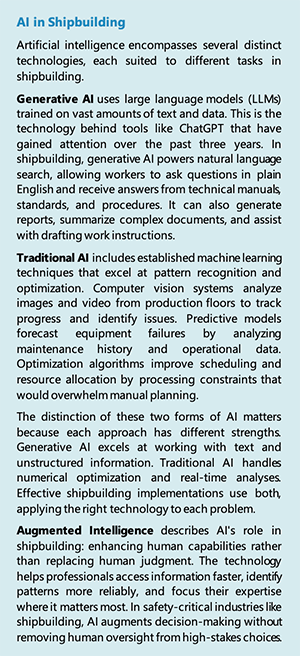
Before diving into solutions, it helps to clarify terminology. When discussing AI in shipbuilding, we’re primarily talking about augmenting intelligence, improving how people can contribute more widely, rather than full work process automation. The goal is to help experienced professionals work more effectively, not to replace human judgment in complex, safety-critical decisions. This distinction matters because shipbuilding involves too many variables, unknowns, and high-stakes choices to simply hand control to algorithms.
CIMdata research and experience shows that shipbuilding differs fundamentally from other manufacturing industries in ways that affect AI implementation. Unlike automotive or aerospace production, where thousands of similar units follow standardized processes, shipbuilders produce small numbers of highly customized vessels. Each project involves unique design decisions, evolving requirements, and lessons learned that should inform future builds. AI systems therefore need to capture and apply company-specific knowledge rather than relying solely on generic industry patterns.
Several factors are driving shipbuilders toward AI adoption. Cost pressures continue to mount as material prices rise and competition intensifies, particularly from Asian shipyards with lower labor costs. Meanwhile, the skilled workforce that built these capabilities is retiring faster than it can be replaced, creating knowledge gaps that threaten operational continuity. More ships are built based on class designs using a platform approach, often shared among different shipyards, placing additional burdens on information control and sharing. Ships themselves are lasting longer, with extended maintenance cycles that demand better predictive capabilities. And regulatory requirements keep expanding, adding compliance burdens that strain existing processes.
AI technology itself has also matured significantly. Large language models (LLMs) can now process natural language queries, making complex data accessible to non-specialists. Computer vision systems can analyze images and video feeds from production facilities. Machine learning models can identify patterns in scheduling and resource allocation that humans would miss. The computational power needed to run these systems is increasingly available at reasonable costs.
But significant barriers remain. Shipbuilding data often exists in fragmented systems, often paper-based, spanning engineering drawings, production schedules, material specifications, quality records, and operational logs. Much of this information is unstructured and difficult to access, living in PDFs, scanned documents, or tribal knowledge rather than databases. Configuration and change management add another layer of complexity. When a ship design evolves over months or years, tracking which version of which component specification applies to which vessel requires rigorous control that many AI systems struggle to maintain. Security concerns are particularly acute in military shipbuilding, where design details, production capabilities, and performance specifications must stay protected.
The industry is also in the middle of a fundamental shift from document-centric to model-centric workflows. Traditional shipbuilding relied heavily on paper drawings and specifications. Modern approaches use 3D models as the authoritative source of truth, with documents generated from these models. The transition creates both opportunity and challenge for AI implementations, which need to work with both legacy document repositories and emerging model-based systems.
Where can AI make a practical difference? CIMdata clients believe the impact spans the ship lifecycle. For example, production planning and scheduling offer clear targets, where AI can optimize resource allocation across parallel workstreams and identify bottlenecks before they cascade. Predictive maintenance is another high-value application, using operational data to forecast equipment failures and schedule interventions during planned downtime rather than reacting after breakdowns occur. Furthermore, compliance checking, particularly against regulatory and classification society rules and standards, represents a time-consuming task that AI can accelerate while reducing human error.
Given these opportunities and challenges, shipbuilders need an implementation strategy that delivers value incrementally while addressing the industry’s unique requirements.
SSI’s AI Adoption and Roadmap for Shipbuilding
SSI’s approach recognizes that AI in shipbuilding isn’t a single technology deployment. It’s a structured evolution that builds on existing data foundations while adding new capabilities in stages. The strategy aims to deliver near-term value while establishing infrastructure for more ambitious applications down the road.
Data Foundation and Open Architecture
The foundation of SSI’s strategy addresses shipbuilding’s data challenges directly. Shipbuilding generates enormous amounts of information across design, engineering, production, commissioning, and in-service phases. This data often lives in incompatible systems that don’t talk to each other. SSI’s solutions are built specifically for shipbuilding workflows, understanding how data flows from initial design concepts through construction and into decades of operational service.
As shown in Figure 1, the open architecture philosophy that defines SSI’s approach matters here. Rather than insisting that a single AI model should handle everything, SSI recognizes that different applications need different models. Design optimization might use one model, scheduling another, and regulatory compliance a third. SSI’s platforms can both power their own AI models and integrate with external ones, giving shipbuilders flexibility to use the right tool for each job.

(Courtesy of SSI)
The “all of the above” data model strategy proves particularly valuable because shipbuilding data comes in many forms. Some is highly structured, like bill of materials databases. Some is semi-structured, like engineering specifications with defined formats but varying content. And some is completely unstructured, like shipboard maintenance logs, inspection notes, or scanned historical documents. Effective AI needs to work across all these data types, extracting useful information regardless of how it’s stored.
A critical challenge is enabling shipbuilders to develop AI models trained on their own data and processes. While industry-wide AI models can provide general guidance, the real value comes from models that understand a specific organization’s design standards, preferred construction sequences, shipyard resources, supplier relationships, and hard-won operational knowledge. SSI’s approach provides the tools and capabilities needed to create these company-specific AI models while maintaining the flexibility to leverage broader industry models where appropriate.
SSI’s platforms provide digital threads and digital twins that maintain traceable connections between design intent, in build process and as-built configurations, and in-service modifications. When an engineer needs to understand why a particular component was specified, or a maintenance team needs to verify which revision of a system is installed on a specific vessel, these digital traces make that information accessible. For AI systems, this traceability provides crucial context that improves accuracy and prevents the system from generating incorrect information.
Staged Roadmap to Augmented Intelligence
SSI defines its AI roadmap in three distinct phases, each building on the previous one while delivering standalone value:
- Phase 1: Data Structuring and Static Queries. This phase focuses on making information more accessible, including that which is stored in the SSI software itself. The initial application embeds AI assistance directly into ShipConstructor and ShipbuildingPLM, helping users navigate features, discover functionality, and get immediate answers to ”How do I…?” questions without leaving their work environment. This dramatically reduces training time and helps users get full value from SSI’s solutions. The phase extends to natural language querying of static documents like maintenance manuals, standard operating procedures, and classification society rules. Rather than forcing workers to search through hundreds of pages of PDFs, AI-powered search lets them ask questions in plain language and get specific answers with source citations. Together, these capabilities reduce time spent hunting for information and accelerate onboarding for new employees.
- Phase 2: Reporting and Natural Queries. The second phase extends AI capabilities to access dynamic data from production systems. This includes generating reports from ERP/MRP, MES, and other production systems, answering natural language questions about current production status, and providing insights into planning and scheduling. For example, a planner could ask, “Which hull blocks are behind schedule and affecting our integration timeline?” or “What material shortages are impacting Zone 3 outfitting this week?” and get answers that synthesize data from production tracking, material management, and resource allocation systems. This represents SSI’s strategy to transition from low-code report generation to no-code natural language queries, making complex data analysis accessible to those who do not have time to configure or code. This phase requires tighter integration with operational systems but offers substantial efficiency gains.
- Phase 3: Creating Information. The third phase represents the most ambitious applications where AI doesn’t just retrieve or analyze information but generates new content. This might include optimizing hanger placement in piping systems based on historical design data, generating work package documentation directly from 3D models, or automatically identifying planning conflicts and recommending schedule adjustments. These applications require the highest data quality, the most sophisticated models, and the most careful validation. They also deliver the greatest potential value by capturing company-specific information and automating time-consuming tasks that currently require skilled specialists.
The time-to-value varies significantly across these phases. Phase 1 capabilities can provide immediate benefits once activated. The embedded software assistance requires minimal setup since it helps users navigate existing SSI solutions, while the document search functionality leverages static documents already in the system. Phase 2 applications require more integration work with operational systems like ERP and production tracking. The time-to-value for this phase varies widely among shipyards as it is heavily dependent on the specific organization’s data quality and integration readiness; however, it requires a substantially greater setup effort than Phase 1. Phase 3 implementations, which generate new information and require the most comprehensive data integration, involve the most substantial setup effort but deliver the highest potential returns.

(Courtesy of SSI)
Within this framework, SSI prioritizes specific applications where shipbuilders can see near-term benefits. Embedded AI assistance within SSI’s software tools represents the most immediate application, helping users discover functionality and answer ”How do I…?” questions without interrupting their workflow. AI-powered knowledge discovery follows closely, giving both experienced staff and new employees natural language access to procedures, standards, and company-specific practices. Together, these address the industry’s workforce challenges by reducing time spent hunting for information and dramatically shortening onboarding periods for new hires. Reporting and planning applications come next, leveraging relatively structured data from existing systems.
Beyond knowledge discovery and reporting and planning applications, SSI is working with partners on using AI to support various use cases for production automation for cutting, welding, nesting, and other production processes where AI can optimize material usage, material handling, and process sequencing. AI-augmented robotics and production strategies represent longer-term opportunities as computer vision and real-time optimization mature.
Integration with Standards and Class Societies
Shipbuilding operates under extensive regulatory frameworks. Classification societies like Lloyd’s Register, ABS, DNV, and others publish detailed rules covering everything from structural strength to fire safety to electrical systems. These rules run to thousands of pages and get updated regularly. Ensuring compliance requires specialists who understand both the rules and the specific vessel design.
SSI’s platform enables shipyards to integrate classification society rules and standards into their AI systems, allowing automated checking of design decisions against requirements. This doesn’t replace the judgment of classification society surveyors, but it can catch obvious violations early in the design process and flag areas that need closer review. It also makes compliance knowledge more accessible to engineers who may not be familiar with every detail of every rule.
The key challenge here is keeping AI models synchronized with rule updates while maintaining the security of a shipbuilder’s proprietary design information. SSI’s approach allows selective access to public standards while keeping company-specific implementations protected.
Security, Compliance, and Flexible Deployment
Data security is particularly critical in military shipbuilding, where vessel designs, capabilities, and production techniques represent closely guarded national security information. This reality shapes both what AI can do and how it may be deployed.
SSI supports multiple deployment models to match varying security requirements. For highly sensitive applications like production planning, shipbuilders can run AI models entirely on-premises, ensuring that no data leaves their secure networks. For less sensitive applications like searching public standards, cloud-based services offer convenience and cost advantages. And hybrid approaches let organizations use the right deployment model for each use case.
SSI’s multi-model strategy proves valuable here too. Rather than forcing all data through a single AI system, organizations can choose which models handle which data types. Sensitive planning information might use an on-premises model trained only on that company’s data, while general engineering queries might leverage broader models that can access more diverse examples.
This security-first approach affects implementation timelines. The most complex Phase 3 applications, which generate new information and require the most data access, take longer to deploy securely than simpler Phase 1 applications that only query existing documents. But this tradeoff is necessary in an industry where a security breach could compromise national defense capabilities.
Configuration and Change Management
SSI’s platforms also include robust configuration and change management capabilities. When AI systems make recommendations based on specific data versions, the system tracks which revision of which specification was used. If that specification changes, affected recommendations can be flagged for review. Such traceability is essential in an environment where ships may be in production for years and undergo modifications throughout their long service lives.
Conclusion
AI offers shipbuilders tangible benefits: reduced design time through faster access to standards and precedents, more efficient production through better resource optimization, lower costs through predictive maintenance, and improved quality through automated checking. These aren’t speculative gains; they reflect capabilities that current AI technology can deliver when properly implemented.
This structured approach makes these benefits accessible to shipbuilders of all sizes. Small yards can start with Phase 1 applications that require minimal infrastructure investment while delivering clear value. Large organizations can pursue the full roadmap, implementing sophisticated planning and optimization systems at the pace of the organization. The common thread is building on solid data foundations and adding capabilities incrementally rather than attempting wholesale transformation.
From CIMdata’s perspective, what distinguishes this approach is the combination of shipbuilding-specific expertise with practical implementation flexibility. The platform understands shipbuilding workflows because they were specifically built for this industry. The open architecture adapts to each organization’s security requirements, existing systems, and preferred deployment models. And the phased roadmap delivers value at every stage rather than requiring years of preparation before seeing results.
From CIMdata’s perspective, several elements stand out. First is SSI’s realistic assessment of where AI can help versus where human expertise remains essential. Second is the recognition that security requirements genuinely constrain what’s possible and when. Third is the practical focus on an architecture that underpins near-term applications that build toward more ambitious goals rather than promising immediate transformation. This pragmatic approach gives shipbuilders a clear path forward in an area where hype often exceeds reality.
Shipbuilders evaluating AI capabilities should consider how proposed solutions handle their industry’s unique challenges. Can the platform work with both legacy documents and modern 3D models? Does it support the security controls military work requires? Will it integrate with existing ERP, PLM, and other production systems? Can it scale from simple document search to complex planning optimization? And does the solution provider understand shipbuilding well enough to provide relevant capabilities and realistic expectations?
CIMdata proposes that the SSI platform addresses these questions directly. The technology strategy is built on years of shipbuilding domain knowledge, the implementation roadmap is structured to deliver value incrementally, and the security model recognizes the industry’s legitimate concerns. Organizations serious about AI in shipbuilding should include SSI in their evaluation process.
To learn more about SSI’s shipbuilding solutions, visit SSI’s website.
[1] Research for this commentary was partially supported by SSI.